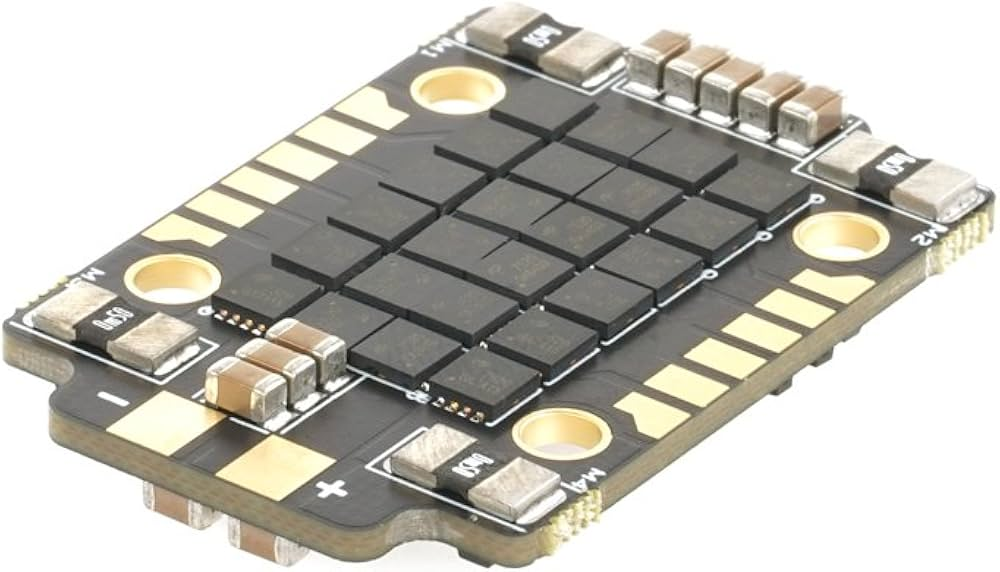
If the flight controller is the brain of your drone, then the Electronic Speed Controller (ESC) is like the nervous system that translates those brain signals into actual muscle movement. ESCs are the unsung heroes that make modern drones possible, yet many beginners don’t fully understand what they do or why they’re so important.
Imagine trying to control the speed of an electric motor with just a simple on/off switch. You’d have two options: full power or no power. That’s it. No way to hover, no way to make gentle adjustments, no way to fly smoothly. This is exactly the problem ESCs solve. They take commands from the flight controller and convert them into precisely controlled power delivery to your motors, allowing for the smooth, stable flight we’ve come to expect from modern drones.
In this article, we’ll explore everything you need to know about ESCs—from what they are and how they work, to the different types available, how to choose the right one, and how to set them up properly. Whether you’re building your first drone or just trying to understand the technology better, this guide will explain it all in simple, easy-to-understand terms.
What is an ESC?
An Electronic Speed Controller (ESC) is a small electronic circuit board that controls the speed and direction of an electric motor. In the drone world, ESCs are crucial components that sit between your flight controller and your motors.
Here’s a simple way to think about it: Your flight controller decides “I need motor 1 to spin at 60% power,” but it can’t directly control the motor—it only sends a small signal. The ESC receives that signal and then delivers the actual electrical power needed to make the motor spin at exactly 60% speed. It’s like the difference between you deciding to accelerate your car (the signal) and the engine actually revving up (the power delivery).
The Basic Function
ESCs perform several critical functions that make drone flight possible:
Speed Control: The primary job is controlling motor speed. When the flight controller sends a signal (traditionally a PWM signal, or newer digital protocols like DShot), the ESC interprets this to determine what speed the motor should spin. It then rapidly switches power on and off to achieve that exact speed, making thousands of adjustments per second.
Power Conversion: Your battery provides Direct Current (DC) power, but brushless motors (used in almost all modern drones) need a special type of power delivery. The ESC converts the DC from your battery into a three-phase AC-like signal that makes brushless motors spin. Don’t worry if that sounds complex—just know that motors can’t run directly from a battery; they need an ESC to convert the power into the right form.
Direction Control: ESCs can also reverse the direction of motor rotation. In drones, this isn’t usually changed during flight, but it’s configured during setup to ensure all motors spin in the correct direction.
Braking: When you reduce throttle, ESCs can actively brake the motor rather than just letting it coast to a stop. This makes your drone more responsive and precise.
How ESCs Work
Let’s dive a bit deeper into the technology behind ESCs without getting too technical.
The Switching Process
Inside an ESC are components called MOSFETs (Metal-Oxide-Semiconductor Field-Effect Transistors). These are essentially very fast electronic switches. The ESC rapidly switches these MOSFETs on and off thousands of times per second to control how much power reaches the motor.
Think of it like a light dimmer switch in your home. Instead of being just on or off, a dimmer rapidly switches the light on and off so fast that your eyes can’t see it, creating the illusion of dimmer light. ESCs do something similar but much faster and more sophisticated.
The rate at which the ESC switches power on and off is called the PWM frequency (measured in kHz). Modern ESCs typically operate at 24kHz or 48kHz. Higher frequencies generally produce smoother motor operation and less electrical noise.
Reading the Signal from the Flight Controller
The ESC needs to know what speed the flight controller wants. This information is transmitted through different protocols that have evolved over time.
PWM (Pulse Width Modulation) is the traditional method and the oldest protocol. The flight controller sends pulses that vary in length from 1000 to 2000 microseconds. A 1000μs pulse means “stop,” while 2000μs means “full throttle,” with anything in between representing proportional speed. PWM is reliable but relatively slow, with update rates around 50-400Hz.
Oneshot125 and Oneshot42 are faster versions of PWM, reducing the pulse length and allowing for quicker updates up to 4kHz. The numbers “125” and “42” refer to the microsecond range of the pulses. Faster communication means the ESC can respond more quickly to flight controller commands. Multishot takes this even further, capable of update rates up to 32kHz, which ultra-fast communication reduces latency between the flight controller’s decision and the motor’s response.
DShot (Digital Shot) represents the modern standard and a significant improvement over analog protocols. Instead of analog pulses, DShot sends digital data packets. This brings several key advantages:
- No need for ESC calibration
- Immunity to electrical noise
- Built-in error checking
- Ability to send commands like changing direction or requesting telemetry
DShot comes in several versions including DShot150, DShot300, DShot600, and DShot1200, where the numbers indicate speed in kilobits per second. Most modern setups use DShot600 or DShot300 as they provide an excellent balance of speed and reliability.
Brushless Motor Control
Brushless motors have three wires coming out, and the ESC needs to energize them in a specific sequence to make the motor spin. The ESC constantly rotates which wires receive power, creating a rotating magnetic field that pulls the motor around.
The ESC must know the motor’s position to do this correctly. It figures this out by detecting something called “back EMF” (electromotive force) generated by the spinning motor. This is why you sometimes hear a little beep sequence when you power up—the ESC is detecting the motor position.
Types of ESCs
ESCs come in various configurations, each suited to different applications and build types.
Individual ESCs vs. 4-in-1 ESCs
Individual ESCs are separate units with one for each motor. They offer several advantages:
- If one fails, you only replace that single unit
- Easier to fit into tight spaces in custom builds
- Can mix and match current ratings if needed
However, they also have some drawbacks:
- More wiring and soldering required
- Take up more space overall
- More potential failure points with multiple connections
Individual ESCs work best for larger builds, custom configurations, and professional applications where redundancy matters.
4-in-1 ESCs (All-in-One) combine all four motor controllers onto a single board. The benefits include:
- Much cleaner build with significantly less wiring
- Reduced weight
- Fewer solder joints to make
- Easier installation process
The trade-offs are:
- If the board fails, you lose control of all motors
- Can be harder to fit in some frames
- More expensive to replace when something goes wrong
These all-in-one units are ideal for racing drones, freestyle quads, clean builds, and beginners who want simplicity.
Many modern drones use a “stack” configuration where the flight controller and 4-in-1 ESC are mounted one on top of the other, connected by small pins. This creates an incredibly clean and compact setup that’s become the standard in the racing and freestyle community.
By Current Rating
ESCs are rated by the maximum current they can handle, measured in amps (A). This is one of the most important specifications to consider when choosing an ESC. Here’s how different current ratings match up with drone sizes:
12A-20A ESCs
- For tiny whoops and micro drones (1-2 inch props)
- Lightweight motors with low power draw
- Examples: Micro racing drones, indoor flyers
20A-30A ESCs
- For 3-4 inch props
- Medium power requirements
- Examples: Cinewhoop-style drones, 3-inch racers
30A-45A ESCs
- For 5-inch props (most common racing/freestyle size)
- Standard for most hobby drones
- Examples: 5-inch racing quads, freestyle rigs
45A-60A ESCs
- For 5-inch props with powerful motors or heavy builds
- Higher-end racing and heavy freestyle drones
- Examples: Long-range builds, X-class racing
60A+ ESCs
- For large props (6-7 inch and beyond)
- Heavy-lift applications
- Examples: Cinematic long-range, heavy-lift photography drones
Important rule: Always choose an ESC rated higher than your actual current draw. If your motor pulls 25A at full throttle, don’t use a 25A ESC—instead opt for at least a 30A or 35A ESC. This safety margin prevents overheating and provides more reliable long-term operation.
By Firmware
Just like flight controllers, ESCs run firmware that determines their behavior and capabilities.
BLHeli_S is the most common ESC firmware for smaller drones. This open-source platform is well-supported by the community and runs on older processors while still being very capable. It supports protocols up to DShot600 and while it’s being phased out in favor of newer options, it remains widely used and perfectly adequate for many applications.
BLHeli_32 represents the newer, more advanced generation of ESC firmware. Running on faster 32-bit processors, it supports DShot1200 and offers better motor timing with smoother operation overall. The firmware includes telemetry support, allowing the ESC to send data back to the flight controller, and provides adjustable settings through dedicated Configurator software. While more expensive than BLHeli_S options, the performance improvement is noticeable.
For larger motors and high-power applications, BLHeli_M was designed specifically to handle the demands of professional and commercial drones. It excels in heavy-lift and long-range builds where reliability under high loads is critical.
AM32 has emerged as an open-source alternative to BLHeli_32. Being completely free to use (BLHeli_32 requires licensing fees for manufacturers), it’s growing in popularity while offering comparable performance. The open-source nature means active community development and no licensing costs passed on to consumers.
KISS (Keep It Super Simple) firmware from Flyduino takes a different approach with proprietary code known for extremely smooth motor output. While premium-priced, it’s popular with high-end racing pilots who appreciate its “just works” philosophy requiring minimal tuning to achieve excellent results.
Special Features
Modern ESCs can include various advanced features that enhance performance and provide valuable data:
Telemetry - The ESC sends data back to the flight controller, including:
- Motor RPM (revolutions per minute)
- Current draw
- Voltage
- Temperature
This information can be displayed in your OSD (On-Screen Display) during flight or logged for post-flight analysis, helping you understand your drone’s performance and power consumption patterns.
Current Sensor - Built-in current measurement allows precise monitoring of power consumption, which is valuable for estimating battery life and analyzing flight performance. This data helps you understand how different flying styles affect your power draw and remaining flight time.
Active Braking - Uses regenerative braking techniques to stop motors faster than simply letting them coast. The level of braking can be adjusted from 0% (allowing motors to coast to a stop) to 100% (aggressive braking), giving you control over how responsive your drone feels during quick directional changes.
Damped Light / Active Freewheeling - An advanced braking mode that makes motors respond more smoothly, especially at low throttle positions. This feature has become very popular in modern racing and freestyle setups because it provides better control feel and more predictable motor response.
Startup Power and Timing - Adjustable settings that affect how motors begin spinning and how the ESC manages motor timing throughout the power range. These parameters can be tuned for different motor types and flying styles, allowing you to optimize performance for your specific setup.
Choosing the Right ESC
Selecting the correct ESC for your build involves considering several factors that work together to determine the best match for your needs.
Match Your Motor and Prop Size
The bigger your motors and props, the more current they’ll draw. Start by checking your motor specifications to find the current draw at full throttle. Add a 20-30% safety margin to this number, then choose an ESC rated above that calculated value. For example, if your motor draws 28A at 100% throttle, you should use at least a 35A ESC to ensure reliable operation with some headroom.
Voltage Compatibility
ESCs are rated for specific voltage ranges, measured in “S” which represents the number of battery cells. Options for 2-4S are suitable for micro and small drones, while 3-6S covers the majority of hobby drones and is the most common range you’ll encounter. For high-voltage racing and long-range builds, 4-8S ESCs are available, and professional heavy-lift applications may require 6-12S capability. Always make sure your ESC can handle your battery voltage, and if you plan to upgrade batteries in the future, choose an ESC that supports the higher voltage now.
Protocol Support
For modern builds, your ESC should support at minimum DShot300, which is adequate for most flying situations. DShot600 is better and has become the standard for racing and freestyle applications. DShot1200 is available if you’re using BLHeli_32 firmware, though this is overkill for most pilots and doesn’t provide noticeable benefits over DShot600 in real-world flying.
Physical Size and Weight
This consideration is especially important for racing and freestyle drones where every gram matters. Smaller, lighter ESCs improve flight performance by reducing the overall weight of your build. Make sure the ESC physically fits in your frame by checking the mounting hole spacing, which is typically standardized at either 20mm or 30.5mm depending on your frame size.
Budget Considerations
Budget ESCs in the $5-15 range typically feature basic BLHeli_S firmware with lower current ratings and fewer features. They’re good for learning and practice builds where you might crash frequently. Mid-range ESCs costing $15-30 often include BLHeli_32 or quality BLHeli_S firmware with good current ratings around 35-45A and telemetry support, making them reliable for most applications. Premium ESCs at $30-60 or more offer high-end BLHeli_32 or KISS firmware, high current ratings of 50-60A and up, advanced features and tuning options, and the best performance and reliability with professional-grade components.
Consider Your Flying Style
Racing demands fast response above all else, making DShot600 or higher essential along with high-quality ESCs featuring low latency. BLHeli_32 is the preferred firmware choice for competitive racing. Freestyle flying benefits from smooth power delivery, with features like active braking and damped light modes being particularly helpful, while telemetry is a nice addition for monitoring performance. Cinematic and long-range applications prioritize reliability most of all, with efficiency also being important. Telemetry becomes quite valuable for monitoring battery status on long flights, though you don’t need the absolute fastest communication protocols. For learning and practice, budget-friendly options are perfectly acceptable since reliability matters more than ultimate performance, and DShot300 is entirely sufficient for developing your skills.
Setting Up and Configuring ESCs
Initial Installation
Wiring Individual ESCs:
- Connect the three motor wires from each ESC to the corresponding motor
- Connect the ESC signal wire to the flight controller’s motor output
- Connect power (positive and negative) from the ESC to your power distribution board
- Note: Motor wire order determines direction; swap any two wires to reverse rotation
Installing 4-in-1 ESCs:
- Mount the ESC securely to your frame
- Connect motor wires to the clearly labeled pads (M1, M2, M3, M4)
- Connect to flight controller (usually through a direct stack connection or cable)
- Connect main power leads to your battery connection point
ESC Calibration (for PWM/Oneshot protocols)
If you’re using older protocols, your ESCs need to learn the throttle range from your system:
- Disconnect propellers for safety
- Power on your transmitter with the throttle stick at maximum
- Connect the battery while your flight controller is in calibration mode
- You’ll hear a sequence of beeps confirming the upper throttle point
- Lower your throttle stick to minimum
- Another beep sequence confirms calibration is complete
Good news: DShot protocols don’t require calibration at all! This is one of their major advantages and another reason why most modern builds have moved to DShot as the standard communication protocol.
Configuring ESC Settings
Using BLHeli Configurator or your ESC-specific software, you can adjust several important parameters to optimize performance.
Motor direction can be set to either “Normal” or “Reversed” depending on your rotation needs. This can be done entirely in software instead of physically swapping motor wires, making it much easier to correct motor directions during setup.
PWM frequency determines how quickly the ESC switches power to the motors. Setting it to 24kHz provides standard operation that works well for most situations, while 48kHz offers smoother and quieter operation at the cost of slightly higher power consumption.
Timing controls how the ESC energizes the motor windings. Auto timing works well for most motors and is a safe default choice. Medium or high timing can improve performance with specific motor types, while low timing is better suited for multi-blade props or high KV motors that need gentler power delivery.
Startup power affects how aggressively the motor begins spinning. Low to medium settings work for most applications, while higher startup power may be needed for heavy props or low-KV motors that require more initial torque to get moving.
Active braking determines how quickly motors stop when you reduce throttle. Start at 0-25% and gradually increase if you want more responsive braking and quicker stops. Be careful not to set this too high, as excessive braking can cause oscillations and unstable flight.
Common Setup Mistakes
One of the most common errors is setting the wrong motor direction. Always check that motors are spinning in the correct direction before attempting to fly. If all motors are spinning the wrong way, your drone will be impossible to control and will flip immediately on takeoff.
Using an ESC with an insufficient current rating leads to overheating and eventual failure. It’s always better to slightly overspec your ESC rather than run it at its absolute limit. The small additional cost is worth the reliability and longevity you’ll gain.
Poor soldering technique is actually the number one cause of ESC problems in the field. Bad solder joints create high resistance connections that heat up, fail intermittently, or break completely. Use proper soldering temperature, good quality solder, and ensure each joint is shiny and properly wetted to the pad.
Many builders forget to add a capacitor to their power system. While many 4-in-1 ESCs include a capacitor on the board, if yours doesn’t or if you’re using individual ESCs, you should add a low-ESR capacitor across the main power leads. This smooths out voltage spikes and protects your ESCs from electrical noise that can cause issues.
ESCs mounted directly to carbon fiber frames without vibration isolation can suffer from solder joints cracking over time due to vibration. If possible, use soft mounting with rubber grommets or foam tape to isolate the ESC from high-frequency vibrations transmitted through the frame.
Troubleshooting ESC Problems
When a motor won’t spin at all, start by checking all solder connections to ensure they’re solid and making good contact. Verify that the motor wires aren’t shorted together, which would prevent the motor from spinning. Confirm that the ESC is actually receiving a signal from the flight controller by checking your wiring and configuration. If everything else looks good, try testing with a different motor to determine if the problem is with the ESC or the motor itself.
If your motor stutters or jitters instead of spinning smoothly, try reducing the timing setting in your ESC configuration. Check for loose connections that might be causing intermittent contact. Make sure your ESC firmware is up to date, as newer versions often fix motor control issues. Also verify that your propellers are properly balanced, as an unbalanced prop can cause vibrations that look like motor problems.
When an ESC gets excessively hot during normal operation, it’s often a sign that the ESC is undersized for your application and you need a higher current rating. Check for high resistance in your connections, particularly solder joints that might not have fully wetted to the pads. You can also reduce the active braking setting, which generates heat. If possible, improve airflow over the ESC by positioning it where it will receive better cooling during flight.
Desync is a frustrating problem where the motor suddenly stops and then restarts. This typically happens when the ESC loses track of the motor’s position. Try reducing the timing setting in your ESC configuration, as aggressive timing can contribute to desync. Check the motor for worn bearings that might be causing irregular rotation. Verify that you’re using an appropriate motor and propeller combination for your ESC’s capabilities. Enable damped light mode if your firmware supports it, as this can help prevent desync. Finally, make sure you’re running the latest firmware version, as desync improvements are common in firmware updates.
If you have no power at all after a crash, begin by carefully inspecting the MOSFETs on the ESC for physical damage like burn marks or cracks. Test continuity on the power traces to ensure electricity can flow through the board. Verify that there are no shorts between the motor wires, which could have been caused by crash damage. Unfortunately, if the ESC has failed due to crash damage, it often needs to be replaced entirely.
Conclusion
Electronic Speed Controllers are essential components that make modern drone flight possible. They bridge the gap between the flight controller’s decisions and the motors’ actions, converting signals into precisely controlled power delivery thousands of times per second. Understanding ESCs—what they do, how they work, and how to choose and configure them—is crucial for anyone building or maintaining drones.
The ESC market has evolved tremendously, from basic speed controllers to sophisticated systems with telemetry, advanced braking modes, and ultra-fast digital communication protocols. Modern ESCs like those running BLHeli_32 or AM32 firmware offer incredible performance and reliability that was unimaginable just a few years ago.
When choosing an ESC, remember these key points:
- Always overspec current rating by 20-30% beyond your motor’s maximum draw
- Match voltage compatibility to your battery (both current and future upgrades)
- Use DShot protocols for modern builds—they eliminate calibration and improve reliability
- Consider 4-in-1 ESCs for cleaner, simpler builds
- Don’t cheap out excessively—reliable ESCs are worth the investment
Whether you’re building a racing drone that needs lightning-fast response, a freestyle quad that demands smooth power delivery, or a long-range explorer where reliability is paramount, there’s an ESC perfectly suited to your needs. Take the time to understand your requirements, choose quality components, and set them up correctly. Your drone’s performance and your flying experience will be much better for it.
Now that you understand ESCs, you’re one step closer to mastering drone technology. Combined with knowledge of flight controllers, motors, and other components, you have the foundation to build, maintain, and optimize drones for any purpose. Happy flying!