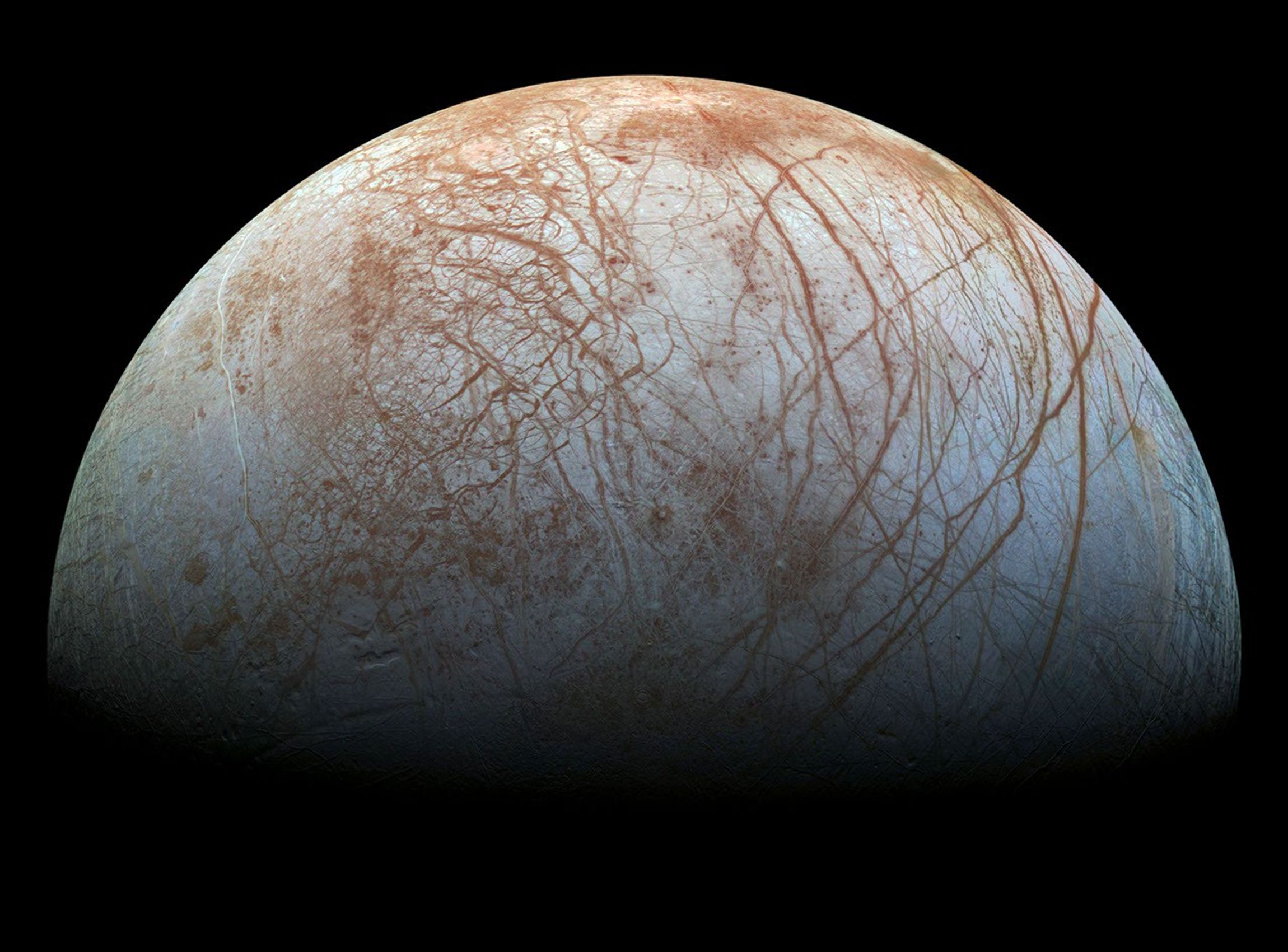
Forty-eight light-minutes from Earth, orbiting the solar system’s largest planet, there is a moon slightly smaller than our own that may contain more liquid water than all of Earth’s oceans combined.
It is covered in ice. It is bombarded by lethal radiation. It is perpetually locked in a gravitational wrestling match with Jupiter and its neighboring moons. And by almost every serious scientific assessment, it is the single most promising place in the solar system to search for extraterrestrial life.
Europa — Jupiter’s fourth-largest moon — has been tantalizing planetary scientists since the Voyager probes sent back their first blurry images in 1979. Those images showed something that had no business existing so far from the Sun: a surface cracked and fractured like a broken eggshell, striated with rust-colored ridges that implied movement, geology, and — most provocatively — liquid water beneath.
Four decades of follow-up observations have only deepened the case. And now, for the first time, we have sent a spacecraft specifically designed to investigate it.
NASA’s Europa Clipper launched in October 2024. It will arrive at Jupiter in 2030. What it finds — or doesn’t find — will shape our understanding of life in the universe more profoundly than almost any other scientific mission in history.
This is what we know, what we suspect, and what hangs in the balance.
Europa 101: Why This Moon Is Different
Europa is not the only moon in the solar system with a subsurface ocean. Enceladus at Saturn, Titan, Ganymede, and Callisto all have strong evidence for internal liquid water. But Europa’s ocean sits in a category of its own — for reasons of chemistry, energy, and accessibility that matter enormously for life.
The Ocean Is Real
The evidence for Europa’s global subsurface ocean is no longer seriously contested in the scientific community. It rests on multiple independent lines of evidence:
Magnetic induction signatures detected by the Galileo spacecraft in the late 1990s showed that Europa generates a secondary magnetic field in response to Jupiter’s powerful magnetosphere — exactly the behavior expected from a layer of electrically conductive saltwater beneath the surface. The signal was unambiguous.
Surface geology tells the same story. Europa’s surface is geologically young — essentially no impact craters, which means the surface is being continuously renewed. The fractured, streaked terrain implies that the ice shell is moving, flexing, and periodically breaking open as the ocean beneath shifts.
Plumes — geysers of water vapor ejecting material from the surface — have been observed by the Hubble Space Telescope on multiple occasions, though they are intermittent and not yet definitively confirmed. If they are real, they represent ocean material being vented directly into space, which has extraordinary implications for sample collection.
The ocean is estimated to be 80–170 kilometers deep — compared to Earth’s average ocean depth of 3.7 kilometers. The total volume of water is estimated at roughly three times Earth’s entire ocean volume. This is not a marginal, marginal environment. It is an ocean of oceanic proportions, kept liquid not by solar heat (which barely reaches Jupiter’s orbit) but by tidal heating — the flexing and squeezing of Europa’s interior by the competing gravitational pulls of Jupiter, Io, and Ganymede.
The Seafloor May Be the Key
Here is what elevates Europa above the competition: the interface between its rocky seafloor and liquid ocean.
On Earth, the most productive ecosystems on the planet’s floor are not coral reefs or river deltas. They are hydrothermal vents — fractures in the ocean floor where seawater contacts hot rock and is superheated, emerging rich in sulfides, methane, hydrogen, and dissolved minerals. These vents, discovered in 1977, host entire ecosystems — tube worms, shrimp, crabs, chemosynthetic bacteria — that derive their energy not from sunlight but from chemical reactions. They are powered by geology, not astronomy.
If Europa’s ocean is in contact with a rocky, potentially volcanically active seafloor — and tidal heating makes this plausible — then hydrothermal systems analogous to Earth’s may exist on the floor of Europa’s ocean. This is not guaranteed. The interior structure of Europa is not fully characterized, and whether tidal heating produces enough energy to drive seafloor volcanism remains an open scientific question.
But if it does, Europa has three things life requires: liquid water, chemical energy, and organic chemistry. The Sun’s involvement becomes optional.
Europa Clipper: The Mission That Might Change Everything
NASA’s Europa Clipper is the most sophisticated planetary science spacecraft ever built for an outer solar system destination. At 30.5 meters wide (solar panel tip to tip), it is also the largest planetary spacecraft NASA has ever flown.
It launched in October 2024 aboard a SpaceX Falcon Heavy and will reach Jupiter in April 2030 after a gravity-assist trajectory through the inner solar system. It will then conduct approximately 49 close flybys of Europa over four years — approaching within 25 kilometers of the surface on some passes — building up a comprehensive picture of the moon that no previous mission has achieved.
Why Flybys Instead of an Orbiter?
The reason Europa Clipper orbits Jupiter rather than Europa directly is Jupiter’s radiation. Europa sits deep inside Jupiter’s magnetosphere, which accelerates charged particles to extraordinary energies. In Europa orbit, the spacecraft’s electronics would be fried within months. By orbiting Jupiter and making repeated, targeted flybys, Europa Clipper limits its radiation exposure on each pass while still accumulating substantial data coverage across Europa’s surface.
Each flyby is carefully targeted to interrogate different regions of the surface, building up a complete map over the mission’s lifetime.
The Instrument Suite
Europa Clipper carries nine primary science instruments, selected specifically for the goals of characterizing the ocean, the ice shell, the surface chemistry, and the potential habitability of the environment:
REASON (Radar for Europa Assessment and Sounding: Ocean to Near-surface) is an ice-penetrating radar that will map the structure of Europa’s ice shell — identifying its thickness, internal layering, and any pockets of liquid water within the ice itself. This instrument will tell us how deep the ocean is and whether there are shallow liquid reservoirs accessible to future missions.
E-THEMIS (Europa Thermal Emission Imaging System) is a thermal camera that maps surface temperature variations. Warm spots in the ice — potential indicators of recent or ongoing geological activity — will be priority targets for investigation.
MISE (Mapping Imaging Spectrometer for Europa) will map the composition of Europa’s surface in detail, identifying the distribution of salts, organics, and other compounds that may have been brought up from the ocean. Surface chemistry is a fingerprint of ocean chemistry.
MASPEX (Mass Spectrometer for Planetary Exploration) will sample Europa’s thin atmosphere and any plume material, directly analyzing its molecular composition. If organic compounds, specific biosignature molecules, or unusual chemical disequilibria are present, MASPEX is the instrument most likely to detect them.
UVS (Ultraviolet Spectrograph) will characterize Europa’s atmosphere and search for plume activity — the single most exciting target for the mission, because confirmed plumes mean ocean material is available for direct chemical analysis without any need to drill through ice.
The collective data from these instruments will, by the end of the mission, produce the most detailed characterization of any potentially habitable ocean world in the solar system. Whether it will answer the life question definitively is another matter — but it will tell us, with unprecedented precision, whether Europa’s ocean is a plausible habitat.
What Kind of Life Could Survive Under Europa’s Ice?
Let’s be precise about what we are — and are not — discussing here.
We are not talking about fish. We are not talking about intelligent life, complex multicellular organisms, or anything that would be recognizable to the naked eye. When scientists talk about life on Europa, they are talking about microorganisms — specifically, extremophiles: life forms that survive, and in some cases thrive, in conditions that would kill most organisms on Earth.
The discovery of extremophile ecosystems on Earth over the past 50 years has dramatically expanded our sense of where life can exist. Before 1977, “habitable” essentially meant “somewhere with sunlight, moderate temperatures, and liquid water at the surface.” That definition has been shattered, systematically, by the discovery of life in environments that were supposed to be sterile.
The Microbial Analogues We Already Know
If life exists in Europa’s ocean, the most likely candidates are analogues to microbes already identified on Earth. Several categories are particularly relevant:
Chemolithotrophs are microorganisms that derive energy from inorganic chemical reactions rather than light or organic carbon. On Earth, chemolithotrophic bacteria and archaea power entire deep-sea vent ecosystems, oxidizing hydrogen sulfide, methane, iron, or hydrogen as their energy source. In Europa’s hypothetical hydrothermal environment, hydrogen and sulfur compounds would be the most likely chemical energy sources, and Earth-analogue organisms like Candidatus Desulforudis audaxviator — a microbe found in South African gold mines 3 kilometers underground, living entirely without sunlight — represent the kind of organism that could, in principle, persist in Europa’s ocean.
Psychrophiles are cold-adapted organisms. Europa’s ocean is estimated to be a few degrees above freezing at most. On Earth, psychrophilic bacteria thrive in Antarctic sea ice, deep ocean sediments, and Arctic permafrost. Colwellia psychrerythraea and relatives remain metabolically active at temperatures approaching –20°C in brine channels. Cold is not, by itself, a barrier to microbial life.
Barophiles (Piezophiles) survive under extreme pressure. The bottom of Europa’s ocean, under 100+ kilometers of water, would experience pressure perhaps 1,000 times greater than Earth’s surface atmospheric pressure. Earth’s hadal trenches — 10+ kilometers deep — host pressure-adapted microbes that require high pressure for optimal function. Europa’s pressure range, while extreme, is not without analogue.
Radiation-tolerant organisms are particularly relevant given that Europa’s surface is bathed in intense ionizing radiation from Jupiter’s magnetosphere. While the ocean itself is shielded by the ice above, any life that colonizes the ice-ocean interface or the ice shell itself would require radiation tolerance. Deinococcus radiodurans — nicknamed Conan the Bacterium — can survive radiation doses thousands of times lethal to humans, repairing DNA damage with extraordinary fidelity. Whether Europan life would have evolved analogous repair mechanisms depends on whether it was ever exposed to radiation during its evolutionary history.
The Energy Question Is Central
The single most important constraint on life in Europa’s ocean is energy availability. Life requires not just the right molecules, but a continuous energy flux to maintain itself against thermodynamic decay.
In a sunlit ocean, energy comes from photosynthesis. In Europa’s ocean, two energy sources are plausible:
Hydrothermal chemistry — if seafloor vents exist — provides chemical energy through the reaction of seawater with hot rock. The hydrogen produced when seawater reacts with olivine and pyroxene minerals (a process called serpentinization) is particularly attractive as a microbial energy source.
Radiolytic chemistry — radiation striking Europa’s ice surface produces oxidants (hydrogen peroxide, oxygen, sulfur compounds) that, if delivered to the ocean through ice cycling, could provide chemical energy for a different class of organisms. This process requires ice shell dynamics that transport surface material downward — plausible but not confirmed.
The two energy sources together potentially create a redox gradient — a chemical imbalance that life can exploit, analogous to the way a battery’s positive and negative terminals drive an electrical circuit. Whether this gradient is present and substantial enough to support a significant biosphere is one of the central questions Europa Clipper will begin to answer.
Scale and Complexity
Even optimistic estimates for a Europan biosphere would likely describe it as sparse, slow-metabolizing, and microbial. The total biomass might be orders of magnitude smaller than Earth’s deep ocean biosphere. Individual organisms might have generation times of months or years, existing in a steady-state equilibrium with a limited energy supply.
This is not a vibrant, teeming ocean. It is, more likely, an ecosystem analogous to Earth’s deep subsurface biosphere — sparse, ancient, slow, and profoundly alien in its relationship to energy and time.
But it would be life. And that changes everything.
How Would We Detect Life on Europa?
This is where the science becomes both fascinating and deeply humbling. Detecting life at a distance of hundreds of millions of kilometers, in an ocean buried under kilometers of ice, using robotic spacecraft, is perhaps the hardest measurement problem in the history of science.
Europa Clipper itself is not a life detection mission. It is a habitability characterization mission. Its goal is to determine whether Europa could support life — not to find life directly. That distinction matters.
Biosignature Detection: What To Look For
A biosignature is any measurable property of an environment that suggests the presence of life, either current or past. Biosignatures exist on a spectrum from “interesting but ambiguous” to “conclusive beyond reasonable doubt.” The history of astrobiology is littered with examples of the former being mistaken for the latter, which has made the field appropriately cautious about extraordinary claims.
For Europa, the relevant biosignature categories include:
Chemical disequilibrium is arguably the most robust general biosignature. Life maintains chemical systems far from thermodynamic equilibrium — it creates and sustains concentrations of molecules that would spontaneously react and disappear in a purely abiotic environment. Earth’s atmosphere, for example, contains both methane and oxygen simultaneously — a combination that shouldn’t coexist without continuous biological replenishment. If Europa’s ocean or plume material contains unexpected chemical combinations that imply a non-equilibrium source, this is significant.
Organic molecule complexity and distribution is another key indicator. Abiotic chemistry produces organic molecules in relatively simple, predictable distributions. Life produces specific molecular structures — particular amino acids, lipids with characteristic chirality, nucleotides — in distributions that differ from purely abiotic synthesis. MASPEX on Europa Clipper will look for organic molecules in plume material; the specific molecules detected and their relative abundances would be scientifically informative even without direct biological detection.
Chiral asymmetry is particularly compelling. Life on Earth uses exclusively left-handed amino acids and right-handed sugars — a preference called homochirality that has no clear abiotic explanation and is thought to be a signature of biological selection. Abiotic chemistry produces roughly equal mixtures of left- and right-handed molecules. If plume material from Europa showed strong chiral preferences in its organic compounds, this would be a significant biosignature.
Anomalous isotope ratios can indicate biological processing. Life preferentially uses lighter isotopes of carbon, sulfur, and other elements, leaving characteristic isotopic signatures in the materials it processes. These signatures can persist long after the organisms themselves are gone.
Cell-like structures would be the most direct morphological biosignature — microscopic objects with membranes, internal structure, or other characteristics of cellular life. Detecting these requires either returning physical samples to Earth (not possible with Europa Clipper) or operating microscopic imaging systems on the surface of Europa itself.
The Plume Opportunity
If Europa’s plumes are real and accessible, they represent the most extraordinary sampling opportunity in the history of astrobiology. Plume material — vented directly from the ocean into space — could be intercepted during a Europa Clipper flyby and analyzed by MASPEX without any need to penetrate the ice shell.
Enceladus, Saturn’s geyser moon, has already demonstrated this is possible. The Cassini spacecraft flew through Enceladus’ plumes multiple times and detected complex organic molecules, hydrogen (suggesting active hydrothermal chemistry), and silica nanoparticles indicative of hot water-rock interaction. No confirmed life biosignatures were found, but the chemistry is provocative — and Enceladus’ plumes are far less energetic and productive than what Europa’s ocean might generate.
Europa’s plumes, if confirmed, would be sampled by Europa Clipper with instrumentation significantly more sophisticated than Cassini’s. A positive result — even an ambiguous one — would trigger immediate advocacy for a follow-on sample return mission.
The Longer-Term Detection Architecture
Definitively detecting life on Europa almost certainly requires landed missions and, eventually, ice-penetrating probes — vehicles that can drill or melt through the ice shell and deploy sensors or samplers directly into the ocean.
This is extraordinarily technically challenging and likely at least 20–30 years away from operational realization. The ice shell may be 15–25 kilometers thick (or potentially thinner in some regions — a key Europa Clipper science goal). Drilling through it requires power, guidance, communication through kilometers of ice, and sterile technique rigorous enough to prevent Earth biological contamination of the very environment being searched.
Several concepts have been studied, including cryobots — self-melting probes that descend through the ice using nuclear power — and hydrobot submarines that would deploy in the ocean after penetrating the ice. These concepts are technically feasible in principle. They remain decades from flight readiness.
What Would Discovery Actually Mean?
Let’s close with the question that sits beneath all the chemistry, engineering, and biology.
If Europa Clipper detects compelling biosignatures — if a subsequent lander confirms microbial life in Europa’s ocean — what does that actually mean for humanity?
The Statistics of the Universe Change Overnight
Currently, we have a sample size of one for life in the universe: Earth. With a sample size of one, you cannot determine whether life is common, rare, or unique. You cannot calculate its probability. You have a single data point and no context.
A second independent origin of life — even microbial, even 628 million kilometers away — transforms the statistics entirely. If life arose independently in two locations within a single solar system, the implication is that the universe is almost certainly saturated with life. The conditions that produce life, rather than being a freakish accident in 13.8 billion years of cosmic history, would be a predictable outcome of chemistry and physics operating at sufficient scale.
Carl Sagan put it most cleanly: “The universe is a pretty big place. If it’s just us, seems like an awful waste of space.” A second genesis doesn’t answer the question of intelligent life elsewhere. But it changes the prior probability so dramatically that the intellectual framework of astrobiology — and, arguably, of human self-understanding — is permanently altered.
The Definition of “Life” Might Need Revision
Earth life is a single, connected family. All organisms on Earth share the same genetic code, the same chirality, the same basic biochemistry. We know all life on Earth descended from a common ancestor. We have never studied life that did not.
Europan life — if it exists and is genuinely independent from Earth life — would be our first example of a second biochemistry. It might use the same amino acids as Earth life or completely different ones. It might use DNA or a different information-carrying polymer entirely. It might have different chirality, different metabolic pathways, different fundamental chemistry.
Studying it would not just tell us about Europa. It would tell us which features of Earth life are universal to life as a phenomenon and which are accidents of Earth’s specific evolutionary history. The boundary between those two categories is one of the deepest open questions in biology — and it cannot be answered with only one example.
The Philosophical Rupture Cannot Be Overstated
Religions, philosophies, and cosmologies across human history have grappled with humanity’s place in the universe. The discovery of extraterrestrial life — even microbial life, even life that cannot think or feel — would constitute the most significant revision to humanity’s self-concept since Copernicus displaced Earth from the center of the universe.
The response would not be uniform. Some religious traditions would find confirmation of their cosmologies in the discovery — many theological frameworks have no difficulty accommodating life elsewhere. Others would experience genuine crisis. The philosophical and cultural processing of the discovery would unfold over decades and would touch questions of ethics, theology, politics, and identity that science itself cannot answer.
There would also be — inevitably — a profound confrontation with what the discovery implies for our responsibility toward that life. The moment another living system is confirmed to exist, questions of planetary protection and the ethics of contamination shift from technical protocols to moral obligations.
The Practical Consequences: Astrobiology as Infrastructure
On a more immediate level, confirmation of extraterrestrial life would trigger one of the largest coordinated scientific investments in history. Every space agency, university astrobiology program, and private research institution would immediately redirect attention toward follow-on missions, biosignature characterization, and eventually, sample return. The field of astrobiology — currently a respected but relatively small scientific discipline — would become one of the central organizing priorities of space science for a generation.
It would also, almost certainly, dramatically accelerate SETI — the Search for Extraterrestrial Intelligence. If simple life is common enough to appear independently in our own solar system, the probability that some fraction of that life evolved toward complexity and intelligence becomes much less dismissible.
What Non-Detection Means
It is worth noting that a negative result — Europa Clipper finding no compelling biosignatures, and subsequent missions confirming the ocean’s chemical environment is hostile or simply empty — would also be scientifically profound.
If Europa’s ocean, with its liquid water, chemical energy, and organic chemistry, does not contain life, then the emergence of life is far more constrained than current models suggest. A lifeless Europa, with all its apparent advantages, would push the probability of life’s emergence sharply downward and force a fundamental revision of the chemistry of life’s origins.
A universe in which a water ocean the size of Europa’s cannot generate life anywhere in billions of years is a much lonelier universe than current astrobiological optimism suggests. And that answer — as devastating as it would be to the field — would still constitute one of the most important scientific findings in history.
The Probability Honest Scientists Will Give You
Ask any planetary scientist what the odds of life in Europa’s ocean are, and you will get answers ranging from “less than 1%” to “better than 50/50.” The honest answer is that we genuinely don’t know — and that uncertainty is itself the most important thing to communicate.
We know Europa has the right ingredients. We know Earth life has demonstrated remarkable adaptability to extreme environments. We know that life arose on Earth almost as soon as conditions allowed — suggesting it is not an extraordinarily improbable event given the right chemistry. We know that hydrothermal systems on Earth reliably host life.
We do not know whether any of Europa’s oceans are actually in chemical contact with its rocky floor. We do not know whether tidal heating is sufficient to drive seafloor chemistry. We do not know how the ice shell dynamics deliver oxidants to the ocean. We do not know whether the origin of life requires conditions we haven’t yet identified.
What Europa Clipper will do, over its four years of flybys beginning in 2031, is systematically reduce that uncertainty. It will not answer the life question. But it will tell us, more precisely than we have ever known, whether the question even makes sense to ask.
And that, in the context of the longest, deepest question human beings have ever posed — are we alone? — is the most meaningful scientific work of our era.
Key Takeaways
- Europa almost certainly harbors a global liquid ocean 80–170 km deep beneath its icy surface, kept liquid by tidal heating from Jupiter’s gravity.
- NASA’s Europa Clipper, launched October 2024 and arriving in 2030, will conduct 49 close flybys to characterize the ocean, ice shell, and surface chemistry.
- If life exists, it is most likely microbial extremophiles — chemolithotrophs, psychrophiles, or piezophiles — analogous to organisms found in Earth’s deep-sea hydrothermal vents and subsurface biosphere.
- Detection would likely begin with chemical biosignatures in plume material: organic complexity, chiral asymmetry, isotope ratios, and chemical disequilibrium.
- Definitive life detection requires future landed missions and ice-penetrating cryobots — technology likely 20–30 years from readiness.
- Discovery would statistically imply life is common throughout the universe, forcing the deepest revision to human self-understanding since the Copernican revolution.
- Non-detection would be equally profound, implying life’s emergence is far more chemically constrained than current models predict.