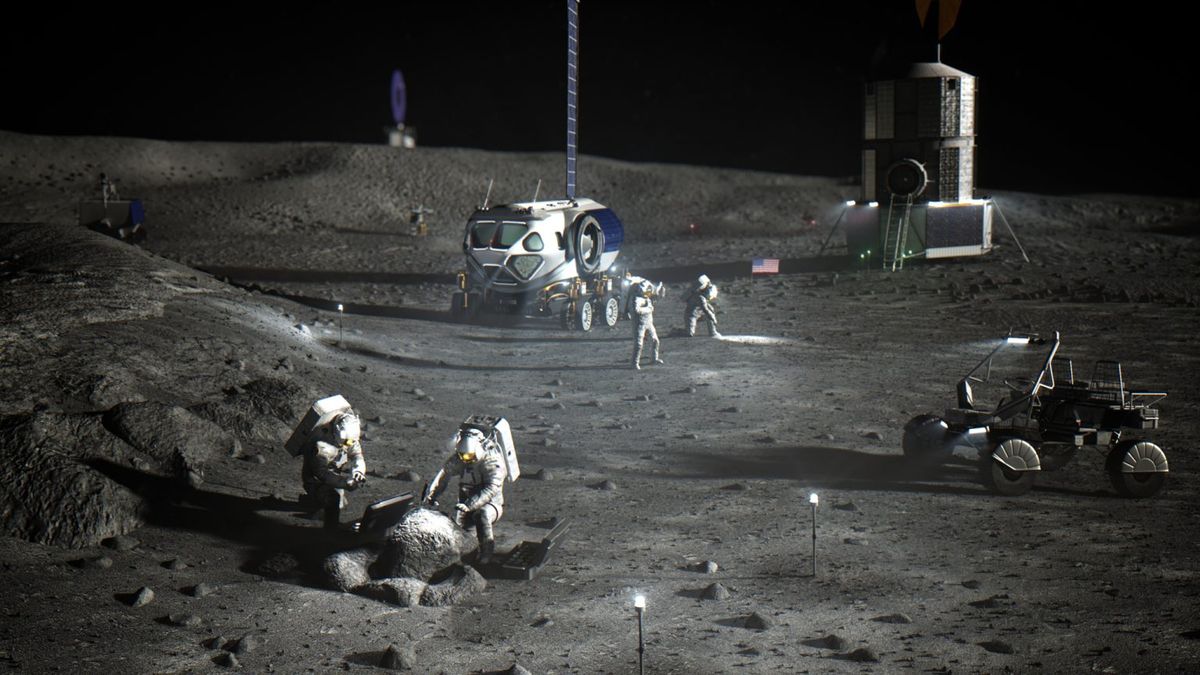
NASA wants people walking on the Moon again by 2026, and they’re aiming for a real, lasting base up there in the early 2030s. SpaceX’s Starship is supposed to provide the ride, and the Artemis program is the big plan guiding it all. Politicians love to talk about it. The concept art? Honestly, it looks incredible.
But let’s get real for a second. The Moon is brutal. Not in a flashy, sci-fi disaster way, but in this quiet, relentless way that ruins electronics, wrecks your lungs, and messes with your DNA.
So here’s the big question: are people actually going to live on the Moon by 2035? Not just a quick visit, not just another flag in the dust — I mean people actually staying there for months, running real operations, building something that sticks around no matter what happens with the next budget fight.
If you really want to know, you have to dive into the engineering. And honestly? The problems are wild, a little terrifying, and nowhere close to being sorted out.
The Artemis Program: What It Actually Plans to Do
The Artemis program isn’t just NASA’s big return to the Moon—it’s way bigger than Apollo ever was. Apollo was all about speed: get there, plant a flag, beat the Soviets, and come home. Artemis? It’s playing the long game. This time, NASA wants to build Gateway, a space station orbiting the Moon, and then set up a permanent base near the south pole.
So why the south pole? It’s all about those shadowed craters. They’re some of the coldest places in the solar system, and people think they’re packed with billions of tonnes of water ice. That ice is the secret ingredient—without it, nobody’s building anything permanent up there.
The program started with Artemis I in 2022, sending an uncrewed Orion capsule around the Moon. Next up is Artemis II, with astronauts flying around the Moon but not landing yet. The big moment comes with Artemis III, aiming for 2026, when astronauts finally touch down again. And here’s where SpaceX and NASA’s stories really cross: Artemis III plans to use SpaceX’s Starship as the lander.
Starship: The Most Important Vehicle in the History of Space Travel
Now, Starship isn’t just another rocket. It’s SpaceX’s moonshot—literally. The idea is to make it fully reusable, rapid to refuel, and able to haul more than 100 tonnes of cargo to the Moon. That kind of payload changes everything. Before, you could only bring a few tonnes at a time, which meant building anything serious was almost impossible. With Starship, it’s just extremely expensive—not totally out of reach.
But, and it’s a big but, Starship still has some massive hurdles. For starters, it needs to refuel in low Earth orbit before heading to the Moon. Nobody’s pulled that off yet. They’ll need multiple tankers, perfect timing, and the ability to transfer cryogenic fuel in space—all before the real mission even starts. SpaceX has done a lot, but making orbital refueling routine is still one of the hardest problems out there.
Then there’s the landing. Starship has to touch down and lift off from the Moon’s surface, which sounds simple but isn’t. The low gravity helps, but the ground is rough and not nearly as well-mapped as you’d like for a pinpoint landing. Plus, those giant engines are going to blast out clouds of lunar dust—regolith—that could cause all sorts of trouble. Honestly, the dust issue is a whole story on its own.
Challenge 1: Radiation
Earth’s magnetic field and atmosphere absorb the vast majority of radiation from the Sun and deep space. The Moon has neither.
On the lunar surface, astronauts face two distinct radiation threats:
Solar Particle Events (SPEs) are eruptions from the Sun that can deliver lethal radiation doses in hours. With enough warning (space weather forecasting is improving), astronauts can shelter. But a shelter needs to exist, and getting to it in time is not guaranteed.
Galactic Cosmic Rays (GCRs) are the more insidious problem. These are high-energy particles streaming in from outside the solar system, and they cannot be blocked by a standard spacesuit or a thin-walled habitat. GCR exposure is chronic, cumulative, and significantly elevates the risk of cancer, cataracts, and potentially neurological damage over missions longer than a few weeks.
Current NASA radiation exposure limits allow for a career dose that a lunar resident might absorb in two to three years of surface habitation. That’s not colonization — that’s a long research posting with a defined endpoint.
Proposed solutions include burying habitats under 2–3 meters of lunar regolith (which provides meaningful shielding), constructing bases inside natural lava tubes (which exist near the lunar poles and could provide both shielding and thermal stability), and pharmaceutical countermeasures currently in development. None of these solutions are mature. Regolith-based construction requires equipment that doesn’t exist yet. Lava tubes near the south pole haven’t been confirmed at the scale needed. And no drug has been proven to meaningfully mitigate long-term GCR damage in humans.
Radiation alone could make permanent lunar habitation medically indefensible under current safety standards — unless those standards are revised or new shielding technologies mature rapidly.
Challenge 2: Lunar Dust
Apollo astronauts were only on the surface for days. By the end of their EVAs, their suits were degraded, their equipment was grinding, and their lungs had been exposed to a substance that, in lab tests, appears to be extraordinarily harmful.
Lunar dust — technically called regolith — is not like Earth dust. It has never been weathered by wind or water, which means every particle is jagged, abrasive, and electrostatically charged. It clings to everything. It infiltrates seals. It scratches visors. It degrades solar panels. And critically, if inhaled in sufficient quantities, its silicate structure may cause lunar silicosis — a lung disease analogous to the condition that devastates miners on Earth.
For a permanent base, dust is a design constraint on every single system:
- Airlocks must prevent dust infiltration during suit-donning and doffing
- Solar panels and radiators must be cleaned regularly or lose efficiency
- Mechanical systems including joints, wheels, and hatches will wear faster than on Earth
- Life support systems must filter dust before it enters habitable volumes
- Human health protocols must prevent cumulative inhalation exposure
Several mitigation strategies are being studied, including electrostatic dust shields that repel particles before they settle, specialized airlock designs, and suit architectures that allow astronauts to “step out of” their suits from behind, leaving the exterior in the airlock. But none of these are fully validated for long-duration use, and dust remains what many engineers consider the most underestimated systems problem in the entire lunar colonization roadmap.
Challenge 3: Power
The lunar day lasts approximately 14 Earth days. So does the lunar night. For a base at the south pole — chosen specifically for its access to near-perpetual sunlight on certain ridgelines — solar power is actually more viable than at the equator. High-altitude “peaks of eternal light” near the south pole receive sunlight for 80–90% of the lunar year.
But 10–20% darkness — potentially weeks-long eclipse periods — requires either enormous battery storage or an alternative power source. Batteries capable of powering a full habitat through a multi-week blackout would be extraordinarily heavy, expensive to transport, and potentially unreliable in the extreme cold of lunar night (temperatures drop to –173°C in shadow).
The leading alternative is fission surface power. NASA and the Department of Energy are developing a small fission reactor system — targeting roughly 10 kilowatts of continuous power — that would be delivered to the surface and operate independently of solar availability. A prototype demonstration is targeted for the late 2020s.
Ten kilowatts sounds modest because it is. A small American home uses roughly 1–2 kW continuously. A lunar base with life support, scientific equipment, water extraction operations, communications, and charging infrastructure for rovers and suits will need far more than 10 kW to be genuinely self-sustaining. Scaling fission power on the Moon requires launching reactors — which requires public acceptance of nuclear launches and regulatory frameworks that don’t fully exist yet.
Power is perhaps the most tractable of the major challenges, but it requires early, sustained investment to be ready by 2035.
Challenge 4: Water Extraction
Here is the core logic of every serious lunar colonization plan: don’t bring water from Earth. Mine it from the Moon.
Water in permanently shadowed craters at the lunar poles — confirmed to exist by multiple orbital instruments, most definitively by India’s Chandrayaan-1 — is the resource that makes everything else possible. Water can be split via electrolysis into hydrogen and oxygen, providing both breathable air and rocket propellant. A lunar base that can manufacture its own propellant is a base that can refuel spacecraft, reducing Earth-dependence and potentially enabling missions deeper into the solar system.
This concept — In-Situ Resource Utilization (ISRU) — is not science fiction. The physics work. The chemistry is established. The problem is everything else.
The water ice exists in permanently shadowed craters where temperatures hover around –250°C. To extract it, you need mining equipment that can operate in near-absolute-zero darkness, with no solar power available, in terrain that has never been directly imaged at high resolution, using drilling or heating techniques that must be validated on actual lunar ice — which no mission has yet attempted on the surface.
NASA’s MOXIE experiment on the Perseverance Mars rover demonstrated oxygen production from CO₂ on Mars — a proof of concept for ISRU philosophy. But lunar water extraction is operationally far more complex, and no equivalent technology demonstrator has yet operated on the Moon.
The water must also be processed to remove contaminants (lunar ice appears to be mixed with regolith, not in pure sheets), stored in cryogenic tanks, and either used directly or processed into propellant through systems that have never operated in the lunar environment at scale.
If water extraction works at scale, the lunar economy becomes real. If it doesn’t — if the ice is too dispersed, too contaminated, or too difficult to access with practical equipment — the entire business case for permanent habitation becomes dramatically harder to defend.
So, Will Humans Live on the Moon by 2035?
Let’s be precise about what “live on the Moon” means, because the answer changes dramatically depending on the definition.
Will humans be on the Moon before 2035? Almost certainly yes, assuming Artemis III or its successor missions succeed. Astronauts will stand on the south pole. They will collect samples, deploy instruments, and spend days — perhaps weeks — on the surface. This is likely within reach.
Will there be a permanent, continuously crewed lunar outpost by 2035? This is where technical honesty requires a more measured answer. The engineering challenges described above are not unsolvable. They are real, serious problems that brilliant people are actively working on — and making genuine progress. But “progress on” and “solved at operational scale” are very different things.
The radiation problem requires either shielding infrastructure (built by robots that haven’t been designed yet), revised safety standards (which requires long-duration health data that doesn’t exist), or pharmaceutical countermeasures (not yet proven). The dust problem requires validated mitigation systems that survive years of continuous use. Power at scale requires nuclear systems that must be launched, landed, and operated reliably. Water extraction requires equipment designed for temperatures and terrain unlike anywhere on Earth, doing chemistry at scales never attempted.
The realistic 2035 scenario is probably this: a small, intermittently crewed research outpost — think a lunar analogue of the early Antarctic stations — where rotating crews of 4–6 spend months at a time, supported by heavy robotic infrastructure, with continuous crewing achieved sometime in the late 2030s or early 2040s. Not a colony. A permanent forward operating base.
That would be, without qualification, the most extraordinary achievement in the history of human civilization. It would be harder, in almost every engineering dimension, than anything humanity has ever built.
The Moon is 384,000 kilometers away. It wants to kill you in six different ways simultaneously. And we are, for the first time in half a century, genuinely, seriously, technically committed to going back and staying.
Whether the timeline holds is a question of funding, political will, and engineering execution. The physics, at least, are on our side.
Key Takeaways
- The Artemis program targets a crewed lunar landing by 2026 and a sustainable surface presence by the early 2030s, using Starship as the primary landing vehicle.
- Radiation from solar events and galactic cosmic rays poses the greatest long-term health risk to lunar inhabitants — current limits may cap continuous habitation at 2–3 years.
- Lunar dust is abrasive, electrostatically charged, and potentially toxic — degrading equipment and posing respiratory risks that are not yet fully mitigated.
- Power generation at the south pole is feasible via solar on ridgelines but requires fission reactors for continuous base operations through eclipse periods.
- Water extraction from permanently shadowed craters is the linchpin of lunar colonization economics — but no surface mining operation has been demonstrated on the Moon.
- A small, intermittently crewed outpost by 2035 is plausible. A true permanent colony is a late-2030s or 2040s proposition, at the earliest.
Sources and further reading: NASA Artemis Program, ESA Moon Village concept, NASA ISRU roadmap, Journal of Geophysical Research (lunar polar water ice studies), NASA Space Fission Power project.